

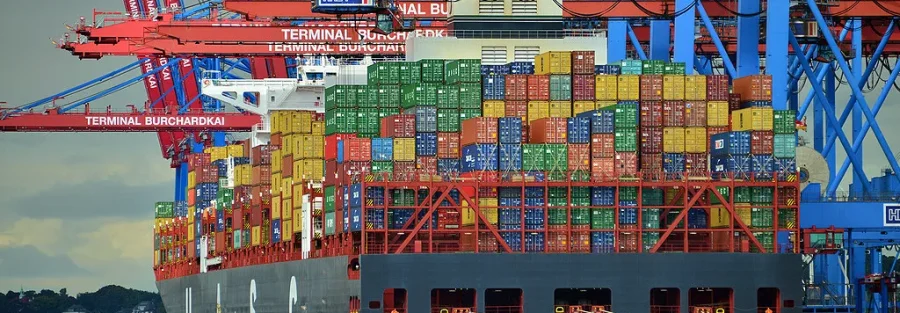
Most foreign companies start with one question about importing goods into Dubai: how much is the duty? The answer is easy to find. It is 5% of the CIF value for most goods. The expensive mistakes come from the three questions that follow it. Who is the importer on the declaration? Is that importer registered for VAT? And do the goods land on the mainland or in a free zone first?
This article walks through the full route for importing goods into Dubai, from the Customs Business Code to the VAT return, and shows who pays what at each point. Every figure comes from Dubai Customs, the Federal Tax Authority (FTA) or the UAE government portal, opened and read in October 2026. I give my own view where the sources leave a decision open, and I say when I am doing that.
Table of Contents
- Importing Goods into Dubai: The Short Answer
- The Route for Importing Goods into Dubai, Step by Step
- How Customs Duty Works When Importing Goods into Dubai
- Import VAT: Who Pays and When
- A Worked Example: One Shipment, Two Importers
- Mainland, Free Zone or Customs Warehouse
- Who Pays What
- Mistakes to Avoid When Importing Goods into Dubai
- What I Could Not Confirm
- FAQ
- Your Next Step
Importing Goods into Dubai: The Short Answer
- Customs duty: 5% of the CIF value for most goods, 50% for alcohol and 100% for cigarettes (UAE government portal, quoting Dubai Customs).
- Import VAT: 5%, calculated on the goods value including customs duty (FTA Taxable Person Guide).
- Who pays when: an unregistered importer pays VAT before release. A VAT-registered importer accounts for it on its return and can usually recover it.
- The licence: to start importing goods into Dubai you need a Customs Business Code, which depends on a valid trade licence whose activities match what you import.
- Free zones: goods entering a designated zone from abroad are outside UAE VAT for that movement. Moving them onto the mainland is an import.
My view is that the decision that matters most is the importer of record. It decides who carries the cash-flow cost of VAT, who is responsible for the documents and who sits in front of the post-clearance audit. Duty is a fixed percentage. The structure around it is where you have real choices.
The Route for Importing Goods into Dubai, Step by Step
Dubai Customs publishes its services in a Customs Service Guide (version 9, 2025) and a Customer Guide. Read together, they describe this sequence for importing goods into Dubai.
- Hold a licence that allows trading. Dubai Customs registers businesses licensed by a competent authority in the UAE or another GCC state. The business type you choose, such as trading importer or exporter, must match the licence activities.
- Register for a Customs Business Code. This is done online through the Dubai Trade portal, with no visit to a customs office. The service guide lists a fee of AED 100, plus a AED 20 knowledge and innovation fee that applies to services costing AED 50 or more. It gives a completion time of one working day. You need the trade licence, the authorised person’s passport and Emirates ID, and an undertaking letter if you are a professional company.
- Decide your VAT position. This comes before the first declaration, not after it. The next section explains why.
- Prepare the documents. The service guide lists the invoice, packing list, certificate of origin and any permit from a restricting authority. For sea freight the Customer Guide adds the bill of lading and a delivery order.
- Submit the customs declaration. Fees for an import declaration range from AED 15 to AED 100 depending on the declaration type and shipping channel. A clearing agent with a Dubai Economic Department clearing and forwarding licence can file it for you, if you authorise them in the customs system.
- Pay duty and, where it applies, VAT. Dubai Customs accepts several payment methods, including credit and debit accounts, standing guarantees and e-payment.
- Submit the supporting documents and keep the records. Details are in the mistakes section below.
Two rules in that list catch people out. The business code is tied to the licence: Dubai Customs says its validity depends on the licence, and it can be renewed only after the licence is renewed. And the code belongs to the licensed entity. Importing under a different company’s code does not move the compliance burden. It adds a counterparty to it.
How Customs Duty Works When Importing Goods into Dubai
The formula is short: customs value multiplied by the tariff rate. The Customer Guide says ad valorem duty is a percentage of the CIF value, and that CIF includes transport, insurance and relevant charges up to the place of importation.
That has a practical effect for anyone negotiating prices with a supplier. If you buy on a free-on-board basis and arrange the shipping yourself, the freight and insurance you pay still enter the customs value. You do not escape duty on freight by splitting the invoice. The Dubai Customs FAQ also confirms that the importer must declare the value of the goods with a supporting invoice, and lists the valuation methods in order of priority, starting with the transaction value.
Three more points on duty, each from Dubai Customs material:
- First point of entry. GCC customs duties are collected at the first customs point of entry in the GCC. If goods arrive in Dubai and are bound for another GCC state, the declaration and duty collection happen in Dubai, and the Customer Guide describes an Automated Transfer of Customs Duty process, known as Makasa, to avoid paying twice.
- Re-export. Goods imported for re-export are secured by a deposit or guarantee equal to the tariff amount instead of duty, and the declaration is limited to goods above AED 20,000 except vehicles. Temporary admission for exhibitions or samples works the same way, with the deposit refunded on re-export. Goods covered by an ATA carnet need no deposit.
- Restricted goods. Some goods need approval from a restricting authority before release, and the approval must go in with the declaration.
Import VAT: Who Pays and When
VAT is where the status of the importer changes the cash outcome. The FTA’s Taxable Person Guide sets out the rules in chapter 9. VAT is due on imports of goods that would be taxable at the standard rate if supplied in the UAE, which is 5%. Goods that would be zero-rated or exempt if supplied locally attract no import VAT.
| Importer status | When VAT is paid | How |
|---|---|---|
| Not registered for VAT | At the point of importation, before the goods are released | Paid to the FTA through its payment portal, separately from customs duty |
| Registered for VAT | On the VAT return for the period of importation | Reverse charge: declared as output tax and, if the normal recovery rules allow, claimed as input tax |
| Registered, goods under duty suspension (temporary admission, customs warehouse, transit, re-export) | Not treated as an import while the suspension holds | The FTA may ask for a guarantee or cash deposit equal to the VAT |
| Goods moving into a designated zone from abroad | No UAE VAT on that movement | VAT becomes due on import if the goods later move to the mainland |
To use the deferral, a registered importer must be able to show it was registered at the time of import and must give the FTA its own customs registration number. The VAT is reported in Box 6 of the return, which the FTA VAT return user guide describes as covering goods declared through UAE Customs. A business that recovers its input VAT in full pays no net VAT on the import. It only carries the timing, and the VAT is due with the return, 28 days after the end of the tax period according to the UAE government import VAT leaflet.
Imports also count towards the VAT registration threshold. The UAE government VAT page says a UAE-based business must register when its taxable supplies and imports exceed AED 375,000 over 12 months, and may register voluntarily above AED 187,500. A trader who imports one large shipment can therefore cross the threshold without selling anything yet. My article on VAT registration in the UAE covers the registration test and the 30-day deadline in detail.
A Worked Example: One Shipment, Two Importers
The numbers below are simple arithmetic using the rates above, not a quotation. I assume a shipment with a CIF value of AED 200,000, a 5% duty rate, 5% VAT, and a VAT-registered importer that can recover its input VAT in full. Declaration fees, clearing agent charges and inland transport are excluded.
| Step | Unregistered importer | VAT-registered importer |
|---|---|---|
| CIF value | AED 200,000 | AED 200,000 |
| Customs duty at 5% | AED 10,000 | AED 10,000 |
| VAT base (CIF plus duty) | AED 210,000 | AED 210,000 |
| Import VAT at 5% | AED 10,500, paid before release | AED 10,500, declared on the return |
| Cash paid at the border | AED 20,500 | AED 10,000 |
| Net VAT cost after the return | Not recoverable, because it is not registered | AED 0, if input tax is fully recoverable |
The gap is AED 10,500 of working capital on a single container, and for the unregistered importer it is also a permanent cost. This is why I do not treat VAT registration as an administrative chore for a company that is importing goods into Dubai regularly. It is part of the commercial model.
Mainland, Free Zone or Customs Warehouse
Where the goods land decides which rules apply to importing goods into Dubai. I use four options as a decision frame. The first two are the common ones. For the wider question of where to hold your licence, see free zone versus mainland, and for the physical side see my guide to a warehouse in Dubai.
| Route | What the sources say | Best when | Watch out for |
|---|---|---|---|
| Mainland importer | Customs declaration, duty, and import VAT (deferred if registered) | You sell mainly inside the UAE and want one clean chain of documents | Cash tied up in duty on stock that sells slowly |
| Free zone importer, designated zone | Goods entering from abroad are outside UAE VAT for that movement | You hold stock for re-export or for several markets | Selling to the mainland is an import, with a declaration and import VAT |
| Customs warehouse | Goods held under customs control without duty or import VAT until sold or re-exported | You want mainland access without paying duty on the whole stock up front | Guarantee requirements and licence conditions |
| Temporary admission or transit | Deposit equal to the duty, refunded on re-export, or no deposit under an ATA carnet | Exhibitions, samples, goods bound for another country | Missing the re-export deadline turns the deposit into duty |
On the customs warehouse row, Dubai Customs’ transit and warehousing booklet describes goods stored under customs control without payment of import duties and taxes until they are sold or re-exported, on condition that a financial guarantee is provided. It adds that importers can delay duty until the goods are used for local consumption.
The FTA’s Designated Zones VAT Guide adds a useful relief. If a VAT-registered business paid VAT when it bought goods inside a designated zone and then pays import VAT again when it moves the same goods to the mainland, it can recover the import VAT in full, whatever its normal recovery percentage. The condition is that the goods are the same and that no other transactions happened in between, with evidence kept. Note also that a free zone is not automatically a designated zone. Only zones that meet the FTA’s conditions are treated as outside the UAE for VAT.
Opinion. A company that will mostly sell to UAE customers should be wary of a free zone structure chosen only because it looks cheaper to set up. Every sale to the mainland will pass through a customs declaration and import VAT. A company that holds stock for re-export is in the opposite position, and the free zone can make good sense. Compare the whole flow of goods, not the licence fee. My article on the cost of setting up a business in Dubai explains how to cost the setup side.
Who Pays What
The question behind this article’s title is really three questions: who pays the authority, who bears the cost in the end, and who is liable if something goes wrong. The table separates them.
| Cost or obligation | Who pays the authority | Who should carry it commercially |
|---|---|---|
| Customs duty | The importer named on the declaration | Set by your contract. It is part of the landed cost |
| Import VAT, registered importer | The importer, through its return | Usually nobody, if fully recoverable |
| Import VAT, unregistered importer | The importer before release | The importer, as a real cost |
| Import VAT through a VAT-registered agent for an unregistered importer | The agent pays the FTA | The agent cannot recover it, so expect it to be charged back to you |
| Declaration and registration fees | The party that files | Usually passed on in the agent’s invoice |
| Late documents, errors, post-clearance findings | The importer of record | Cannot be shifted to the authority. Allocate it in the agent contract |
The agent row comes straight from the FTA guide: where an unregistered importer uses a VAT-registered agent such as a courier, the agent pays import VAT to the FTA, accounts for it on its own return, cannot recover it, and issues the importer a statement of the import and the VAT paid. Read your agent’s terms for how that is charged to you.
Mistakes to Avoid When Importing Goods into Dubai
- Treating 5% as the total cost. The landed cost of importing goods into Dubai also includes VAT cash flow, fees, agent charges, storage and delay.
- Submitting the documents late. Dubai Customs requires the declaration documents within 30 days of processing. After that, a late fee of AED 5 per day applies for up to 106 days, and refund claims for duty or deposits are not accepted until the documents are complete.
- Losing the paper trail. Dubai Customs runs post-clearance audits on a customer’s transactions. Mainland companies must keep customs declarations and supporting documents for five years, and free zone companies until their business closes.
- Forgetting that imports count toward the VAT threshold. Check your trailing 12-month imports as well as sales.
- Choosing the structure before the flow. Decide whether goods will be re-exported, sold on the mainland or both, then pick the licence.
- Ignoring restricted goods. Permits from the relevant authority must be obtained before clearance, not during it.
What I Could Not Confirm
I want to be clear about the limits of this article. The FTA Taxable Person Guide I cite is the June 2018 issue, and the Designated Zones guide is the July 2018 issue. They are the versions the FTA hosts at the addresses linked above, and the UAE government import leaflet was written for the introduction of VAT on 1 January 2018. VAT rules have since been amended, so check the current FTA guidance before you rely on procedural detail.
I did not verify the current list of designated zones, the duty position for each product category, or the fee schedule beyond the version 9 service guide. Dubai Trade help pages I tried to open for registration were not available, so the registration steps come from the Dubai Customs guides. Nothing here is legal or tax advice. For a specific plan for importing goods into Dubai, confirm the HS code and rate with Dubai Customs and the VAT treatment with the FTA or a tax adviser.
FAQ
What is the customs duty on goods imported into Dubai?
Dubai Customs and the UAE government portal both state the tariff as 5% of the CIF value of the goods, with two exceptions: 50% for alcohol and 100% for cigarettes. CIF means cost, insurance and freight up to the place of importation. Some goods carry different rates or exemptions under the tariff, so check the HS code of your product before you quote a landed cost.
Do I need a trade licence to import goods into Dubai?
To clear goods through Dubai Customs you need a Customs Business Code. Dubai Customs registers businesses licensed by a competent authority in the UAE or another GCC state, and the business type you register must match the activities on the licence. A licence that does not include trading activity is therefore a problem to fix before the first shipment, not after it.
Do I have to be VAT registered to import goods into Dubai?
Registration is not a condition for importing, but it changes how you pay. A VAT-registered importer accounts for import VAT on its return. An unregistered importer must pay import VAT to the Federal Tax Authority before the goods are released. The value of your imports also counts towards the AED 375,000 mandatory registration threshold.
Is importing goods into a free zone free of duty and VAT?
The FTA treats goods moved into a VAT designated zone from outside the UAE as outside the scope of UAE VAT for that movement. Moving the same goods from a designated zone into the mainland is treated as an import, so import VAT applies and a customs declaration is needed. Confirm the duty position for your goods with Dubai Customs or the zone authority before you rely on it.
Your Next Step
Before the first shipment, write down three things about importing goods into Dubai: who will be the importer of record, whether that entity is or will be VAT registered, and where the goods will land. Then compare the landed cost under each structure using the worked example above. If your next question is about finding suppliers or coordinating the shipment itself, GoldVestra, part of the Goldvest Horizon ecosystem, covers import coordination and offers a logistics coordination service. If you want to talk through how importing fits your wider UAE setup, you can contact us here.